A Parent's Guide to Story Books for Toddlers
Discover the magic of story books for toddlers. This guide helps you choose the right books, create personalized stories, and make reading a cherished activity.
Story books for toddlers are so much more than just a way to pass the time. They're the first real tools we have to help build their language, spark their imagination, and even teach them about empathy. The best ones are usually pretty sturdy (toddler-proof pages are a must!), use simple, catchy language, and have big, bright pictures that a little one can't help but stare at.
The Unforgettable Magic of Story Time
Walking into a bookshop and seeing shelves overflowing with colourful books can be a bit much. Where do you even start? Every cover screams "pick me!" and promises a grand adventure. But hidden in that pile is the perfect key to unlocking your toddler's world. The right story book isn’t just a pleasant distraction; it's a powerful way to connect and help them grow, turning a few quiet minutes into a memory that sticks.
This guide is about more than just telling you reading is good for kids—you already know that. We’re going to dig into how story books for toddlers are the first real building blocks for essential life skills. Through engaging pictures and simple tales, your child starts to get a handle on big ideas, from understanding their own feelings to learning about the world beyond their window.
Building More Than a Library
Every book you open together helps build a rich, vibrant inner world for your toddler. Think of it less like filling a bookshelf and more like planting a garden. Each story is a seed. That seed can grow into a new idea, a deeper emotion, or a bigger vocabulary. It’s no surprise that study after study shows how reading to little ones early on has a huge impact on their development.
It can be as simple as pointing to a picture of a dog and saying the word "dog." That tiny action strengthens connections in their brain, making it easier for them to pick up language. Or when a character in a book looks sad and your toddler points to their tears, it opens up a safe, easy way to start talking about feelings.
Reading aloud to young children isn't just a cosy activity—it's a critical brain-building exercise. It’s one of the best ways to lay a strong foundation for future learning and their emotional well-being.
Our aim here is to give you the confidence to make every story session matter. You'll soon be able to spot the books that really click with where your child is at and learn how to turn story time into a powerful moment of learning and bonding.
A New Chapter in Storytelling
And it's not just about the classic tales we all grew up with. New ideas are making reading even more exciting for our kids. We'll also look at how personalised stories are changing the game for early literacy. Just imagine a book where your child is the hero of the story, exploring a world that looks and feels a lot like their own. This creates an instant connection to the tale, kicking off a reading journey that is truly one-of-a-kind and helps foster a genuine, lifelong love for books.
Choosing the Perfect Story Book for Your Toddler
What turns a simple book into a treasured favourite, with dog-eared pages and a well-loved spine? It often comes down to a few key ingredients that perfectly match a toddler's developmental stage. When you know what to look for, picking out story books for toddlers stops being a guessing game and becomes a confident, joyful part of parenting.
Think of it like being a detective building your child's first library. The clues aren't hidden; they're right there in the book's design, its language, and the pictures that fill its pages. Let's break down exactly what makes a book brilliant for this age group, starting with the very first thing your toddler will notice: how it feels in their hands.
Built for Little Explorers
Before a toddler can even follow a story, they explore a book with their hands and, let's be honest, sometimes their mouths. That’s why the physical construction is so important. A book needs to be tough enough to survive enthusiastic page-turning, the occasional toss from the high chair, and general toddler curiosity.
You’ll want to look for a few specific features:
- Board Book Format: Thick, sturdy cardboard pages are a must. They can withstand grabbing, chewing, and rough handling far better than flimsy paper.
- Rounded Corners: Sharp corners are a definite no-go for little ones. Rounded edges make the book safer for them to hold and explore on their own.
- Manageable Size: The book should be small and light enough for your toddler to hold themselves. This encourages a sense of ownership and independence during story time.
These physical traits make a book inviting and safe, encouraging your child to interact with it long before they can read the words. This hands-on exploration is a vital first step on their reading journey.
The chart below shows just how foundational story books are for a toddler's emotional and cognitive growth.
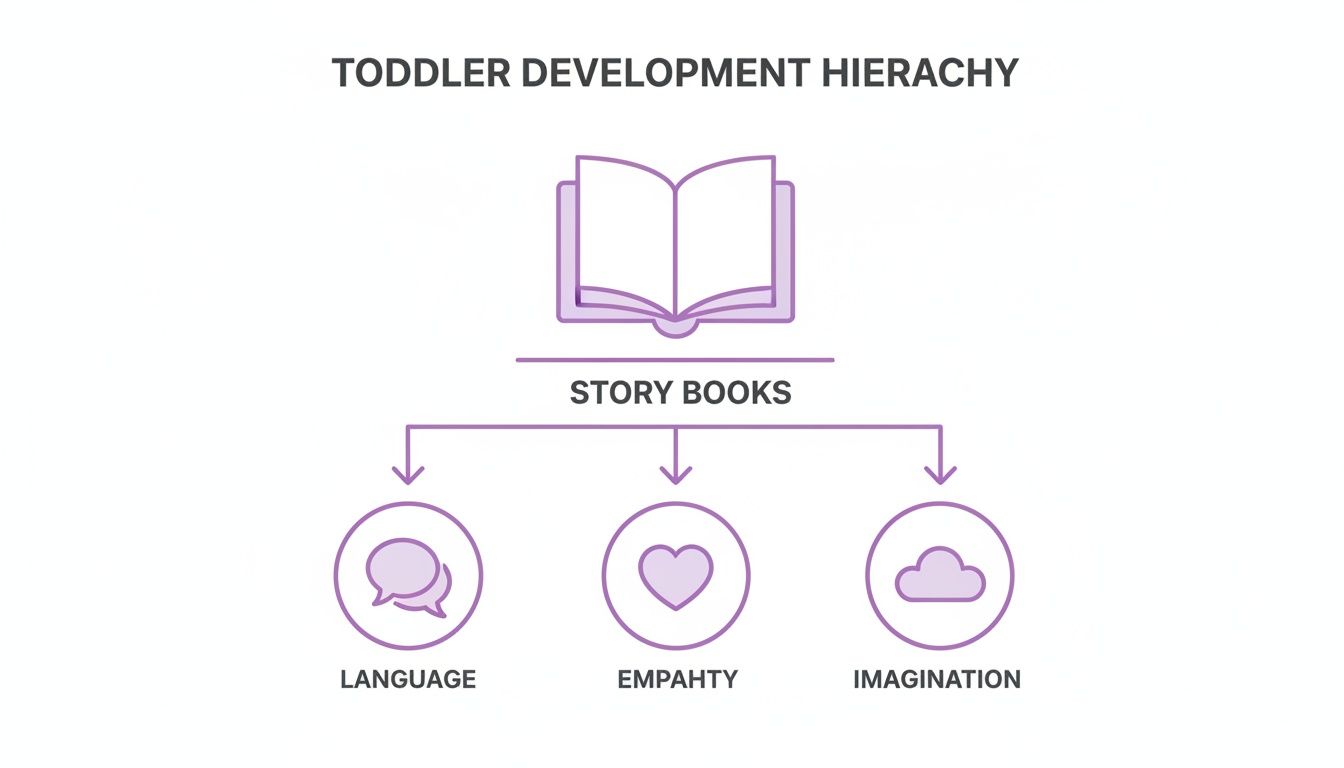
As you can see, a single book can nurture multiple areas of development at once, from building vocabulary to fostering kindness and creativity.
Content That Connects and Teaches
Once you’ve found a book that’s built to last, it's time to look inside. The content—the words and pictures—is where the real magic happens. For toddlers, simplicity and repetition are your best friends.
A toddler's brain is rapidly forming connections, and repetition helps cement them. Hearing the same phrase or rhyme over and over isn't just comforting; it's a powerhouse for language acquisition. It helps them predict what's coming next, which builds their confidence and makes reading an interactive game.
When a toddler chimes in on a repeated phrase, they aren't just memorising words. They are actively participating in the story, building the neural pathways necessary for language and comprehension.
Vibrant, clear illustrations are just as important as the text. Toddlers are highly visual learners, and the pictures provide crucial context for the story. Look for illustrations that are simple, uncluttered, and clearly show what's happening. If the text says, "The big red ball bounced," the picture should show exactly that. This direct link between words and images is how they begin to understand that print has meaning.
To help you find the best fit, here’s a quick breakdown of what makes the content of a toddler book truly effective.
Key Features of Developmentally Appropriate Toddler Books
This table connects the features you see in a book to the incredible developmental work happening in your toddler's brain.
| Feature | Why It Matters for Toddlers | Example | | ----------------------- | ------------------------------------------------------------------------------------------------------------------------- | -------------------------------------------------------------------------------- | | Simple, Repetitive Text | Builds predictability and memory. Hearing phrases again and again helps toddlers learn new words and sentence structures. | "Brown bear, brown bear, what do you see?" repeated on each page. | | Rhyme and Rhythm | Makes language musical and fun. The singsong quality captures a toddler's attention and makes words easier to remember. | Dr. Seuss books or classic nursery rhymes. | | Clear, Bold Illustrations | Helps them connect words to objects and actions. They learn what a "dog" or "jumping" looks like. | A large, simple picture of a cat corresponding to the word "cat." | | Relatable Themes | Stories about daily routines (bedtime, meals), feelings, or animals connect the book to their own life experiences. | A story about a little bunny who doesn't want to go to bed. | | Interactive Elements | Engages their sense of touch and curiosity. Lift-the-flaps or textured patches keep fidgety toddlers focused and involved. | "Where's Spot?" books where you lift flaps to find the character. |
By keeping these features in mind, you can choose books that do more than just tell a story—they actively support your toddler's learning.
Ultimately, choosing the right story books for toddlers isn't about finding the most complex plot or the most artistic illustrations. It’s about finding books that meet them exactly where they are. By focusing on durability, repetition, and clear visuals, you can select stories that will not only entertain your child but also lay a strong foundation for a lifetime of happy reading.
Why Personalised Stories Captivate Young Readers
Picture this: your toddler’s face lights up, their eyes wide with wonder, as they hear their own name in a story. They see a little hero on the page who looks just like them, setting off on a grand adventure. That’s the magic of a personalised book. If a regular story is a window into another world, a personalised one is a mirror, showing them they’re at the very centre of the universe.
This simple tweak—from passive observer to active participant—changes everything. It turns storytime from a quiet activity into a truly immersive, magical experience. When children see themselves as the hero of the tale, it sends a powerful message that sinks in deep: you matter, your story is important, and you can do amazing things.
The Psychology of Seeing Themselves in the Story
The moment a toddler hears their name or spots a familiar detail in a book, their brain snaps to attention. It’s no longer just a story; it’s about them. This personal connection is more than just a novelty; it’s a powerful tool for building a solid foundation for early literacy and emotional growth.
Personalised stories give children a profound sense of ownership. This isn't just any book on the shelf; it's their book. That feeling is a huge confidence booster, getting them far more invested in the act of reading. In fact, one study on early literacy found that kids showed up to 40% higher engagement levels with personalised material compared to standard, off-the-shelf stories.
When a child sees themselves as the main character, the story’s lessons become their lessons. The character’s bravery becomes their bravery. That deep, personal link helps them internalise positive messages and build real self-belief.
This spike in engagement has a direct, practical benefit: it improves comprehension. Because they’re so tuned in, toddlers are much more likely to pick up new words, follow the plot, and understand the core message of the story.
Making Abstract Concepts Concrete and Relatable
Let’s be honest, the world can be a big, confusing place for a toddler. Personalised storybooks can be a fantastic way to gently introduce new situations or tricky ideas. For example, a story about a character with their name and appearance getting ready for preschool can do wonders to calm any first-day jitters.
By placing the child in a familiar context within the narrative, even complex ideas suddenly become much easier to grasp.
- Navigating New Experiences: A story about their character going to the doctor can demystify the experience, making a real-life check-up feel less scary.
- Understanding Big Feelings: A tale where their character feels sad and learns how to talk about it gives them the language to express their own emotions.
- Building Empathy: Seeing their character help a friend in need teaches social skills in a way that feels personal and immediate.
This approach can be particularly helpful for neurodiverse children. The predictability of a story that mirrors their own life and routines can be incredibly comforting and provide a clear, reassuring framework for exploring the world.
Sparking a Lifelong Love for Reading
At the end of the day, what we all want is to raise children who genuinely love to read. Personalised stories are one of the best ways to get there because they make books feel special and exciting. That pure joy of being the hero creates a positive association with reading that can last a lifetime.
This isn’t just a passing trend; it’s a movement reflected in the booming children’s book market. In India, for instance, a strong push for early literacy is fuelling incredible growth in children's publishing. Market analysis shows India’s portion of the Asia-Pacific market hit a 13.65% market share in 2025, which translates to about $545.102 million in sales revenue. This surge opens up amazing possibilities for platforms creating AI-customised storybooks that weave in culturally relevant details, truly making toddlers the heroes of their own unique tales. You can discover more about this growing market and the impact of personalised content.
By making your child the star of the show, you’re not just giving them a fun story. You’re giving them a gift that nurtures their self-worth, deepens their understanding of the world, and just might ignite a passion for reading that will benefit them for years to come.
Creating a Personalised Story Book Step by Step
Ready to become your child's favourite author? The idea of making a book from scratch can sound a bit intimidating, but today’s tools make it a wonderfully simple and joyful process. You don't need to be a writer or an artist—just a little imagination and a few spare minutes.
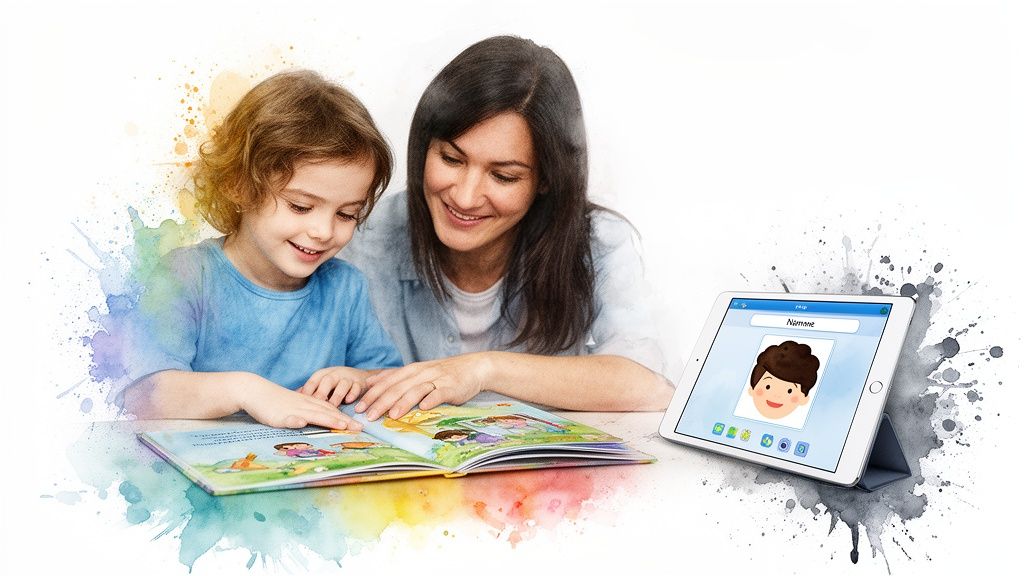
Think of this guide as your creative co-pilot. I’ll walk you through how a platform like MioTales lets you craft a unique story with your toddler right at the heart of the action. It handles all the heavy lifting, leaving you with all the fun. By the end, you’ll be ready to create a one-of-a-kind keepsake.
Step 1: Build Your Little Hero
First up, the most exciting part: creating the main character. This is where you bring your child into the story, making them the star from page one. Platforms designed for creating story books for toddlers make this process feel like a fun game.
You’ll start by defining the hero’s key features. This usually includes things like:
- Name: Simply putting your child's name in the story is the most powerful personal touch you can make.
- Appearance: You can select details like hair colour, eye colour, and skin tone so the character is a mirror image of your toddler.
- Optional Photo Upload: Some services let you upload a photo, which an AI then uses to generate a character that looks just like your child.
This is about more than just looks; it's about representation. When a child sees a hero who looks just like them, it helps them feel seen and important, giving their self-esteem a little boost with every story.
Step 2: Choose the Perfect Adventure
With your hero ready to go, it’s time to pick their adventure. The best platforms have a whole library of age-appropriate themes that speak directly to a toddler’s world and spark their imagination.
The options are tailored to their interests and experiences. You’ll often find themes such as:
- Bedtime Stories: Gentle, calming tales that are perfect for winding down at the end of a busy day.
- Adventure Quests: Simple but exciting plots about exploring a magical forest or discovering a hidden treasure.
- Learning Stories: Fun narratives that playfully introduce basic concepts like colours, numbers, or animal sounds.
- Daily Routines: Stories that turn everyday activities like brushing teeth or sharing toys into something special.
Choosing a theme that taps into your child’s current obsession—whether it’s dinosaurs or diggers—or introduces a new experience makes the story instantly more captivating.
Step 3: Customise the Look and Feel
Now that the character and plot are set, you get to decide on the visual style. The illustrations are what truly bring story books for toddlers to life, and having control over the art adds another amazing layer of personalisation.
You can pick from different artistic styles to match the story's mood. For example, a soft Watercolour style might be perfect for a gentle bedtime story, while a bright and bold Cartoon style could make a lively adventure pop off the page. This choice makes sure the final book looks just the way you imagined it.
A big question for parents is data privacy, especially when a photo is involved. Good platforms are built with this in mind. For instance, systems like MioTales automatically delete any uploaded photos right after the character is created, so you can be sure your family’s data stays secure.
Step 4: Generate and Share Your Masterpiece
This is where the magic happens. Once you’ve made your choices, the platform does its work, weaving your character, theme, and art style into a complete, beautifully illustrated story. In just a few minutes, you’ll have a finished book ready to go.
The final story is usually delivered as a high-quality, print-ready PDF, which gives you total flexibility. You can:
- Read it right away from a tablet or phone for instant story time.
- Print it at home for a quick, homemade version.
- Send the file to a professional printer to create a sturdy, glossy keepsake that will last for years.
Creating personalised baby books and toddler stories has never been easier, giving you a powerful way to connect with your child and build a lifelong love of reading.
Turning Story Time into a Daily Adventure
The real magic of a storybook isn’t just what’s on the page—it’s the shared experience you build around it. With a bit of playfulness, you can transform reading a book from a simple task into a thrilling adventure that strengthens your connection and lights up your toddler's imagination. This is how story time evolves from a routine into a treasured ritual.
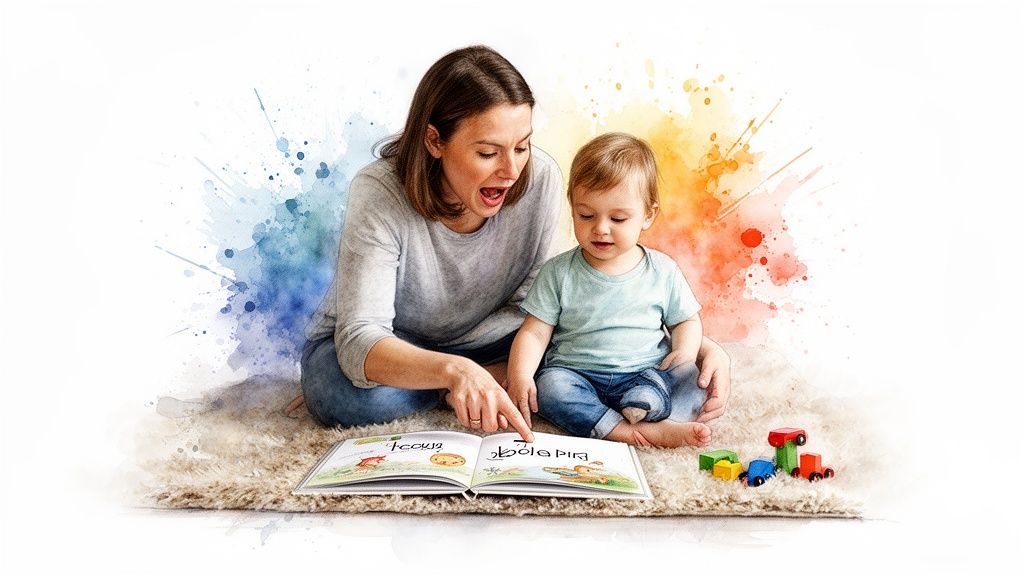
It’s all about creating an interactive, multi-sensory moment. Think of it as the difference between passively hearing a story and actively jumping into it. When you bring a story to life, you’re inviting your little one to step right into the narrative, making the characters and their world feel incredibly real and exciting.
Bring the Story to Life with Your Voice
Your voice is by far your most powerful storytelling tool. Instead of reading in a single, flat tone, try playing with your pitch, pace, and volume to mirror what’s happening in the story. This simple shift helps your toddler grasp emotions and keeps them completely captivated.
- Try a high, squeaky voice for a tiny mouse.
- Use a deep, booming voice for a friendly giant.
- Whisper during a suspenseful part to build anticipation.
- Laugh out loud right along with the characters.
Don't worry about giving a perfect performance! This is all about having fun and showing your toddler that reading is an expressive, joyful activity. Your own enthusiasm is infectious and makes every storybook you share that much more memorable.
The goal is connection, not perfection. When you animate your reading, you're modelling how stories can make us feel, teaching emotional intelligence alongside literacy.
Make Reading an Interactive Dialogue
Turn reading from a monologue into a lively conversation. Simply pausing to ask questions invites your toddler to think more deeply about the story and link it to their own world. The trick is to ask open-ended questions that can’t be answered with a simple "yes" or "no."
Give these a try:
- "What do you think is going to happen next?"
- "How do you think the little bear is feeling right now?"
- "Look at that silly hat! Where have we seen a hat like that before?"
These little breaks give their busy minds a moment to process the plot, make predictions, and share their own thoughts. It’s a wonderfully natural way to build crucial comprehension and communication skills.
Engage Their Senses and Build Print Awareness
For toddlers, learning is a hands-on experience. Bringing their sense of touch into the picture helps connect them to the physical book and the idea of written words. As you read, gently guide their finger to trace along with the words on the page.
This simple act introduces them to the concept of print awareness—the understanding that all those squiggles on the page represent the words you're saying. It’s a vital first step on the journey to recognising letters and, one day, reading all by themselves.
Here in India, this focus on early education has sparked a renaissance in children’s literature, with traditional tales being reimagined for modern families. With a massive population of 158 million children aged 0-6, the importance of early literacy has never been clearer. A recent survey found that 76% of Indian parents now read to their toddlers every day, a wonderful increase showing just how valued this time has become. Studies also show this early exposure can boost word recognition skills by an incredible 30% in children aged 3-5. Learn more about the market growth in children's publishing.
By making story time an interactive and fun part of your day, you’re doing so much more than just reading a book. You’re laying a solid foundation for a lifetime of learning and making precious memories together. To help you celebrate every story you share, you might like to use a tool like our printable reading log for kids.
Creative Ways to Use Story Books Every Day
Story time doesn't have to be just for winding down before bed. Honestly, toddler storybooks are some of the most versatile tools in a parent's back pocket. When you start thinking of them less like entertainment and more like gentle guides, you can weave them into the fabric of your day to help your little one make sense of their world.
They can turn a tricky moment of anxiety into a chance to be brave, or a simple family routine into a cherished memory. It’s all about seeing books as a practical, powerful part of your everyday life together.
Preparing for New Adventures
Let's face it, new experiences can be a bit scary for a toddler. That first haircut, a trip to the dentist, or even starting a new playgroup is a big deal when you're small. A storybook can be the perfect dress rehearsal.
By reading a simple, upbeat story about a character who gets their hair cut, you're demystifying the whole process. They see the friendly barber, hear the buzzing clippers in the story, and see the happy result—all from the safety of your lap. It turns a potential fear into a familiar adventure. This trick works for countless situations, from doctor's visits to the first day of preschool.
Think of it like this: using a story to preview an event gives your toddler a mental map. This preparation helps them feel more in control and dials down the anxiety, making the real thing feel much more manageable.
It’s a wonderfully gentle way to build up their resilience and courage, one page at a time.
Stories as Gifts and Keepsakes
A thoughtfully chosen storybook is so much more than just another toy. It’s a keepsake, a memory-maker, and a way to strengthen those precious family bonds. When a grandparent or auntie gifts a book, it becomes a tangible reminder of their love. Every time you read it together, you're reinforcing that special connection.
Personalised books take this to a whole new level. A story created just for them, with their name and maybe even a character that looks like them, is a treasure. It’s not just a book; it’s their book, a snapshot of their childhood that says, "You are the star of this story."
A Tool for Classrooms and Big Feelings
Teachers have known the secret for years: thematic stories are pure gold. In a classroom, a book about sharing can kickstart a conversation about kindness. A story about autumn can anchor a whole week of learning about nature. Why not borrow this technique for home?
You can use books to help your toddler understand and navigate those huge emotions they're feeling. A story about a little bear who gets angry and learns to take deep breaths gives your child a real strategy they can try themselves. This makes story books for toddlers one of the best resources for building social and emotional skills.
The demand for these kinds of learning tools is booming, especially in the Asia-Pacific region. Led by countries like India, the children's picture book market captured 23% of global revenue in 2024, reaching a massive $1,084.5 million. Research has even shown that Indian toddlers who read picture books have 25% better vocabulary retention, which really highlights the incredible impact these stories can have. You can read more about these regional market insights.
If you’re inspired to create your own little learning tales, you can get some great ideas from these helpful story prompts for kids.
Answering Your Top Questions About Toddler Story Books
Even when you're excited to start, getting into the rhythm of reading with a toddler can bring up a few head-scratchers. You want to do what's best and build habits that stick, right? Let's clear up some of the most common questions we hear from parents just like you.
How Often Should We Be Reading?
Honestly, as often as you both enjoy it! If you can aim for at least one dedicated story time a day, that's brilliant. But the real secret is consistency, not the clock. A truly engaged ten-minute read before bed will do more good than a distracted, rushed half-hour.
Most parents find it helpful to weave reading into a daily routine—maybe right after their bath or just before you tuck them in for the night. This turns story time into a comforting, predictable ritual they’ll start to look forward to. The main thing is to keep it fun and free of pressure.
My Toddler Just Won't Sit Still for a Story! What Do I Do?
First off, take a deep breath. This is completely, 100% normal. Toddlers are little bundles of energy with famously short attention spans. The aim isn't to pin them down, but to make reading a lively, interactive game. If they need to wiggle, stand up, or even act out the story, let them!
Here are a few things that can help:
- Pick books with interactive elements, like flaps to lift or different textures to feel.
- Keep your reading sessions short and sweet. It's always better to stop while they're still having fun.
- Let them be the official page-turner, even if they skip a few. It gives them a sense of control.
- Go all out with your performance! Use funny voices, make animal sounds, and really get into it. Your energy is contagious.
Remember, even if they're bopping around the room while you read, their little ears are still tuned in.
Is It Okay That We Read the Same Book Over and Over... and Over?
Yes, absolutely! In fact, it's one of the best things for their growing minds. When your toddler asks for the same story for the tenth night in a row, they're not trying to drive you mad. Their brain is firing on all cylinders.
Repetition is a superfood for learning. It's how toddlers lock in new words, figure out how stories work, and build confidence by knowing what's coming next. Every time you reread a book, you're strengthening those important language pathways in their brain.
So, lean into it. When a book becomes a favourite, it's a sign that it’s clicking with them and giving them exactly what they need developmentally. Soon enough, you’ll hear them “reading” their favourite lines right back to you. The best story books for toddlers are always the ones with the well-worn, crinkled pages.
Ready to make a story your toddler will want to hear again and again? With MioTales, you can create a gorgeous, personalised book that puts your child right at the centre of the adventure. Start making those magical memories today. Create your first story with MioTales!
Related Free Tools
If this post helped, these tools will help you keep going right away.